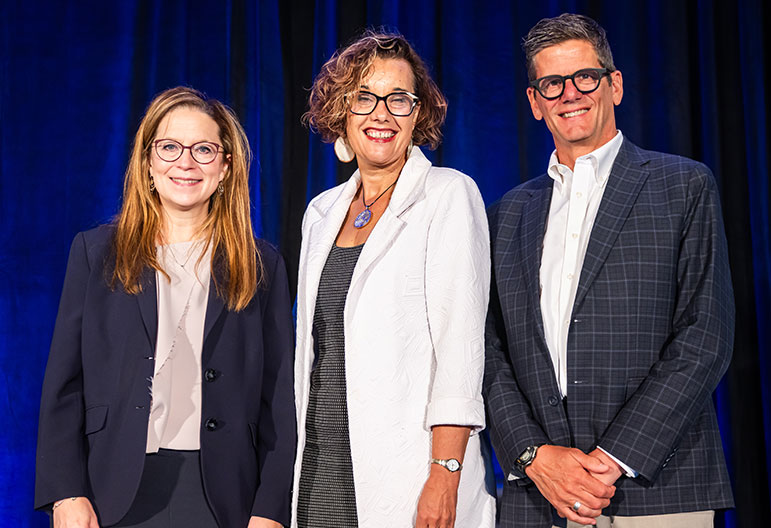
It’s about feeling connected and valued. During challenging times, people often feel disconnected, which can lead to moral injury and burnout. Physicians are no different, according to opening plenary speakers at ABMS Conference 2025 who discussed how the medical community is providing tools that physicians can use to move forward and flourish.
A framework for flourishing
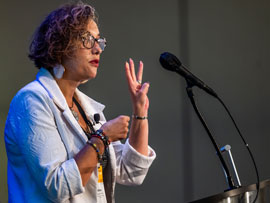
While systemic issues can and must be addressed, challenging times can also serve as an opportunity for physicians to reflect on why they chose the medical profession in the first place and the importance of their work serving patients, noted Kimara Ellefson, MBA, EdD, National Director of Strategy and Partnerships at the Kern National Network for Flourishing in Health (KNN).
“Research shows that grounding ourselves in what first brought us to the work we do and the people that we work alongside and serve is an incredible antidote to languishing and burnout,” she said. “More positively stated, it helps us move toward flourishing.”
Dr. Ellefson discussed elements of KNN Framework for Flourishing, in which flourishing is defined in part as “realizing one’s potential and helping others do the same.” Across the country, more than 50 organizations are engaging with KNN and its framework in various ways to address complex workforce and culture challenges in their systems. The most recent annual KNN Conference drew 260 participants from 90 unique organizations, demonstrating this aim resonates strongly across health professions. Character, caring, and practical wisdom are the elements that comprise this framework.
Character is a constellation of characteristics formed over time and manifest in dispositions and practices, she said. “We are made up of different values, virtues, and characteristics, and it is those values and virtues that shape how we respond to a particular situation or moment,” Dr. Ellefson said. “Grounding ourselves in these virtues and values enables us to step forward as leaders in our spaces and places of influence with integrity and authenticity instead of adopting a sense of learned helplessness.” In KNN’s work with partners and leaders across the country, this is frequently cited as a powerful practice for shifting mental models.
Caring is a blend of practices, dispositions, and motivations, all aimed at ensuring the individual and populations grow, develop, and flourish as best they can, Dr. Ellefson said. She distinguished between caring “for” and “with” others. The latter requires creating environments that encourage seeing that someone needs care, stepping in and doing what is necessary, and understanding that such care is bidirectional and impacts both parties. Caring is an essential part of reaching our full human potential, and when done in this way, it can transform how people interact with one another, Dr. Ellefson said. Integrating caring into day-to-day organizing norms can transform individuals, institutions, communities, and even democracy, she added.
Practical wisdom is a virtue that helps people understand how to navigate “the times we live in and the institutions we’re a part of,” Dr. Ellefson said. It involves using acquired experience to discern the right way to do the right thing in a particular circumstance, with a particular person, at a particular time. Using practical wisdom helps people understand how to integrate experience and reflection to work toward changing behaviors and actions as well as systems and structures.
Dr. Ellefson suggested that these elements can be used not only to flourish in medical practice but also in the ABMS community’s efforts to transform certification. Ensuring that physicians are competent is essential but so is making sure that the process to ensure competency does not reduce human flourishing. She suggested that leaning into character and caring as individuals and, importantly, as an organization can help drive this transformation. Practical wisdom can help navigate through this work and execute it well so that it encourages and supports the well-being of all within the system.
AMA addresses burden, burnout
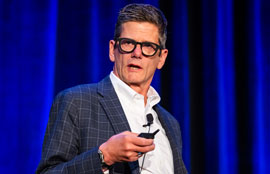
The United States health system, including the organizations where physicians work, are major contributors to burnout, stated John S. Andrews, MD, Vice President of Graduate Medical Education Innovations at the American Medical Association (AMA). “While burnout manifests in individuals, it originates in systems,” he said. Physicians, however, have more control than they think over their practice environment, which is the focus of the AMA’s framework for organizational well-being.
Two central components in the framework are the AMA Organizational Biopsy® and Joy in Medicine®. The Organizational Biopsy is an assessment tool and a set of services that support health care systems in holistically measuring and taking action to improve the health of their organizations. This assessment looks across four domains: organizational culture (e.g., leadership, teamwork, and trust); practice efficiency (e.g., team structure and workflows); self-care in response to stress; and the intention of the workforce to remain in the roles they serve. After completing this assessment, organizations receive an executive summary of their key findings. They also have access to national data that provides benchmarks for the work that they’re doing.
Approximately 150 health systems across the country are engaged with the Organizational Biopsy, Dr. Andrews said. Key performance indicators of organizational well-being are satisfaction, stress, burnout, intent to leave, and feeling valued. Studies suggest that all these indicators are moving in the right direction, he noted. Burnout levels have declined and are approaching pre-COVID levels. Job satisfaction is inversely related to stress and burnout. When physicians’ administrative burden is reduced, their intent to leave drops and their sense of feeling valued rises.
The Joy in Medicine® Health System Recognition Program provides a roadmap for health system leaders to implement programs and policies that mitigate burnout and support physician well-being. The program unites the health care community in building a culture committed to increasing joy in medicine for the profession nationwide. The Joy in Medicine program is based on organizational achievement in six competency areas that are evaluated through self-assessment and supporting documentation.
To date, 164 organizations across 40 states and the District of Columbia are in a two-year recognition cycle. “We think this is creating momentum in the marketplace for change, and we hope it will drive policy development as more large health systems engage in the effort,” Dr. Andrews stated.
At the organizational level, the AMA Steps Forward® Program offers a suite of resources – including webinars, publications, and videos – designed to implement change and mitigate burnout, while supporting physician well-being. Among the practice innovation topics are time-saving strategies, electronic health record improvements, and behavioral health integration.
“When the community sees other health systems engaging in these activities, they learn from one another,” Dr. Andrews said. “And it builds awareness about solutions that promote joy in medicine and spur investment within health systems to reduce physician burnout.”
Supporting physician wellness
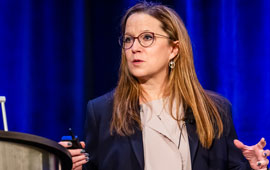
The American Board of Emergency Medicine (ABEM) is working to promote a sense of belonging, community, and pride in the specialty, stated Melissa A. Barton, MD, ABEM’s Executive Director of Professional and Clinical Affairs.
About six percent – or nearly three million – patients each year wait longer than 24 hours for a bed in the emergency department. Stranded in the emergency room on a stretcher, they wait to be transferred to a bed upstairs or another facility. “That is where the moral injury is coming from,” Dr. Barton said. “We are not burnt out on the specialty of Emergency Medicine. We are burnt out on the system in which we must practice.”
More recently, ABEM has shifted how it communicates with board certified Emergency Medicine physicians (also known as diplomates) by amplifying their voice and promoting the physician behind the certification. “Previously, we only spoke about protecting the public,” she said. “In today’s world, that sounds very patriarchal, distant, and outdated.”
“While Member Boards are not professional societies, we have a role to play in supporting physician well-being,” Dr. Barton said. ABEM supports such efforts as the Dr. Lorna Breen Heroes’ Foundation and Stop the Stigma EM campaign. “In this day and age, there is no reason physicians should have to check off on a medical license application that we are seeking mental health treatment,” she stated. Along those lines, ABMS has issued policies and statements that support physicians seeking care for a mental health or substance use disorder as well as for those who uphold standards in specialty care that is grounded in science, she noted. Dr. Barton encouraged Member Boards to consider opportunities to collaborate in support of physician wellness.
ABEM amplifies the physician voice by sending letters of recognition to diplomates whose work and contributions make the news and sends congratulatory messages to diplomates on long, successful careers. These letters are very well received, Dr. Barton noted.
The board also looks to reduce the burden of diplomates. ABEM convened the Coalition of Board-Certified Emergency Physicians, which has successfully removed the need for short courses or additional certifications that diplomates complete as part of continuing certification. ABEM has developed continuing certification modules on substance and opioid use disorders that meet Drug Enforcement Agency requirements. ABEM offers reciprocity, when possible, to give diplomates credit through its MyEMCert modules for activities they’re already doing. The board is considering adding new subspecialties and focused practice designations, which recognize a diplomate’s body of expertise, in hopes of increasing career satisfaction, she said. ABEM compiles Key Advances that highlight clinical policy alerts and practice advancements, saving diplomates time and effort to stay current.
ABEM offers additional formats for activities – audio and video recordings, and podcasts – understanding that physicians are increasingly “taking their education on the go,” and not sitting in front of a computer reading PDFs, Dr. Barton stated. Podcasts that amplify the physician voice include ABEM Voices, which feature conversations with diplomates from across the country, and ABEM Pathways, which helps residents navigate the path to board certification. Replacing “stock photos” with pictures of real diplomates and sending “welcome kits” to new diplomates are other ways that ABEM shows its support.
“At ABEM, we are working to promote physicians and the work they do. We know doing that will enhance patient safety and quality of care,” Dr. Barton said. “It’s about recognizing that the vast majority of physicians are doing an outstanding job.”
© 2026 American Board of Medical Specialties
-
Read More:
- ABMS Conference |
- Member Boards |