
Applying to the ABMS Scholars Program
The 2026-2027 ABMS Scholars application cycle will open on March 22, 2026.
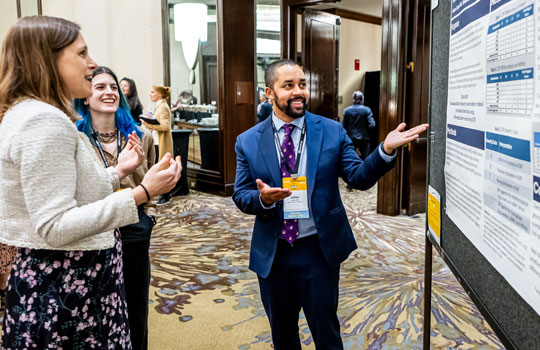
Join us for an Informational Webinar
April 28 from 5:00-6:00 PM (CT)
You’ll hear from program leaders on how to apply and from alumni about the benefits of participating in the ABMS Scholars Program.
During the program year, ABMS Scholars remain at their home institutions and work with self-selected mentors. They provide research project updates during monthly webinar sessions and get feedback and guidance from their peers, mentors, subject matter experts, and ABMS Scholars Program alumni. Scholars attend virtual ABMS committee meetings and present their research findings before a national audience at the annual ABMS Conference. An award of $15,000 is provided to support the direct costs of research and travel expenses associated with program participation.
Application Information
Applicants should consider the impact of their proposed research project on reducing health disparities and contributing to the development of a qualified and diversified workforce. Applications to the ABMS Scholars Program are completed through the Cadmium Abstract ScoreCard platform. Contact the ABMS Scholars Program for questions regarding the application process.
Important Dates
- Application Period Opens: March 22, 2026
- Informational Webinar: April 28, 2026 at 5:00 pm (CT)
- Application Deadline: June 22, 2026 at 11:59 pm (CT)
- Notification of Award: August 5, 2026
- Scholar Year Start: September 2026 at ABMS Conference
- Scholar Year Concludes: September 2027 at ABMS Conference
2026–2027 Research Priorities
Four scholars will be selected to advance one or more research priorities established by the ABMS Research and Education Foundation (ABMS REF).
ABMS Scholars may be sponsored by the ABMS REF OR by a co-sponsoring ABMS Member Board. The following research priorities pertain to either initial or continuing certification, within or across specialties:
- Diagnostic and clinical reasoning excellence
- AI’s potential for optimization of these skills for learning and quality/performance
- Adoption of competency-based medical education and innovative assessments
- Board certification assessments of professionalism in training or in practice
- Competency-based medical education’s impact on longitudinal assessment programs
- Health care equity and diversity across the continuum of physician professional development
- Trainee and diplomate engagement in quality and safety activities, especially related to improving physician well-being
- Intersection between a physician’s work, technology (e.g., electronic health records or artificial intelligence), and certification
Additional scholars will be selected to advance one or more research priorities of the co-sponsoring ABMS Member Boards (click on the Member Board to expand and read more about their research priorities):
American Board of Anesthesiology
Research priorities of the American Board of Anesthesiology include:
- Next-generation assessment formats (beyond MCQ)
Research and validation of alternative assessment modalities appropriate for anesthesiology (e.g., expanded OSCE approaches; other formats that better capture performance/skills than MCQs). - Adaptive learning and personalized continuing certification
Evidence for the effectiveness, fairness, and educational impact of adaptive learning approaches embedded in continuing certification (including models that personalize assessment/learning pathways). - Using ABA performance data to support continuing medical education (CME)
Research on how to translate aggregate diplomate performance data into actionable insights for educators and CME developers, including what data is most useful and how to present it. - Assessment of “holistic” skills in anesthesiology certification
Methods to define, teach/learn, and assess leadership, management, professionalism, communication, and team-based skills—especially via OSCEs and case-based longitudinal items. - Trainee engagement and early formative assessment
Evidence for formative tools and earlier engagement during residency (e.g., what program/resident feedback is most useful; impact on readiness, learning, and professional development).
American Board of Allergy and Immunology
Research priorities of the American Board of Allergy and Immunology include:
- Diagnostic and clinical reasoning excellence
- AI’s potential for optimization of these skills for learning and quality/performance
- Adoption of competency-based medical education and innovative assessments
- Board certification assessments of professionalism in training or in practice
- Competency-based medical education’s impact on longitudinal assessment programs
- Health care equity and diversity across the continuum of physician professional development
- Trainee and diplomate engagement in quality and safety activities, especially related to improving physician well-being
- Intersection between a physician’s work, technology (e.g., electronic health records or artificial intelligence), and certification
American Board of Dermatology
Research priorities of the American Board of Dermatology include:
- Trend analysis of high-performing and poor-performing ABD assessment questions, identifying question characteristic trends to follow or avoid
- Artificial intelligence use, validity, and reliability in assisting to compose evidence-based critiques for board-style self-assessment questions
- Competency-based assessment strategies beyond medical knowledge assessment, including procedural and in-office microscopy diagnostics assessment
- Outcomes assessment of ABD CertLink, including diplomate assessment of relevance, time, stress, value
- Outcomes of implementing the APPLIED Exam, including diplomate assessment of the Applied exam
- Integration of cultural competency principles into the ABD assessment continuum
- Analysis to explore if any demographic biases are identified in ABD assessments (once collecting AAMC demographic data)
- Relationship of Core Exam results with Applied Exam Results, and Core Exam module results with corresponding fellowship Subspecialty Certification Exam results
- Practice-related quality measures among board-certified dermatologists
American Board of Emergency Medicine
The American Board of Emergency Medicine is sponsoring a scholar through the J. David Barry, MD, Scholar Fellowship for emergency medicine physicians with:
- Experience as a military physician;
- Interest in physician wellness research such as burnout, fitness, and mindfulness;
- Interest in residency education and research;
- Innovations in continuing certification assessment and education; or
- Interest in medical toxicology
American Board of Internal Medicine Foundation
Research priorities of the American Board of Internal Medicine include:
- Diagnostic and prognostic excellence through initial or continuing certification, within and across specialties
- Adoption of competency-based medical education and innovative assessments for initial or continuing certification
- Health care equity and diversity across the continuum of physician professional development
- Trainee and diplomate engagement in quality and safety activities, especially if related to improving physician well-being
- Intersection between a physician’s work, technology (e.g., electronic health records or artificial intelligence), and certification
- Investigating the evolution of medical professional values and assessment of professionalism in an evolving healthcare landscape
American Board of Obstetrics and Gynecology
The research priorities for the American Board of Obstetrics and Gynecology George D. Wendel, Jr., MD Scholar include:
- Demonstrating the Value of Certification
Board certification represents a national commitment to maintaining clinical competence and advancing patient safety. However, more research is needed to understand how certification processes contribute to measurable improvements in patient care and workforce effectiveness.
ABOG seeks research examining:- Relationships between certification status or maintenance of certification activities and patient outcomes
- The role of technical skills assessment in maintaining clinical excellence
- How certification-related assessments (e.g., QE, CE, CREOG) relate to workforce outcomes such as practice patterns, quality of care, or malpractice risk
- Methods for demonstrating the public value of certification in improving clinical care and system performance
- Leveraging Technology and Virtual Consultation
Digital technologies offer new opportunities to extend the reach of specialty expertise. Projects should focus on real-world implementation and scalability, particularly in rural or underserved settings.
Relevant topics may include:- Telemedicine and virtual consultation networks
- Digital tools that support care coordination and clinical decision-making
- Artificial intelligence or predictive analytics that improve triage, risk stratification, or health disparities
- Patient trust in artificial intelligence tools or in practices and physicians who employ artificial intelligence
- Simulation technologies that enhance clinical training and technical skills assessment
American Board of Ophthalmology
Research priorities of the American Board of Ophthalmology include:
- Investigating the relationships among board certification, physician education, clinical performance, patient outcomes, and career-long improvement.
- Advancing the evidence base on physician competence, including its definition, assessment, development, and longitudinal measurement.
- Defining the emerging role of artificial intelligence in certification processes, including its implications for assessment validity, fairness, security, and continuous learning.
- Developing approaches to evaluating and quantifying the value, impact, and return on investment of certification programs and related activities.
American Board of Orthopaedic Surgery
Research priorities of the American Board of Orthopaedic Surgery include:
- Diagnostic and clinical reasoning excellence
- AI’s potential for optimization of these skills for learning and quality/performance
- Adoption of competency-based medical education and innovative assessments
- Board certification assessments of professionalism in training or in practice
- Competency-based medical education’s impact on longitudinal assessment programs
- Health care equity and diversity across the continuum of physician professional development
- Trainee and diplomate engagement in quality and safety activities, especially related to improving physician well-being
- Intersection between a physician’s work, technology (e.g., electronic health records or artificial intelligence), and certification
American Board of Otolaryngology – Head and Neck Surgery
Research priorities of the American Board of Otolaryngology – Head and Neck Surgery include:
- Diagnostic and prognostic excellence within and across specialties
- Adoption of competency-based medical education and assessments across certification programs
- Advanced, innovative formats of resident and diplomate asessment
- Assessment of professionalism throughout the duration of the surgeon’s career – residency through retirement
American Board of Pediatrics
Research priorities of the American Board of Pediatrics include:
- Diagnostic and clinical reasoning excellence
- AI’s potential for optimization of these skills for learning and quality/performance
- Assessment of AI competencies and the impact on patient care
- Adoption of competency-based medical education and innovative assessments
- Competency-based medical education implementation in training
- Impact of AI on learning and/or assessment in a competency-based medical education system
- Board certification assessments of professionalism in training or in practice
- Competency-based medical education impact on longitudinal assessment programs
- Health care equity and diversity across the continuum of physician professional development
- Trainee and diplomate engagement in quality and safety activities, especially related to improving physician well-being
- Intersection between a physician’s work, technology (e.g., electronic health records or artificial intelligence), and certification
- Demonstrating the value of certification
- Relationships between certification status or continuing certification activities and patient outcomes
- Methods for demonstrating the public value of certification in improving clinical care and system performance
American Board of Physical Medicine and Rehabilitation
Research priorities of the American Board of Physical Medicine and Rehabilitation include:
- Quality and safety concerns in Physical Medicine and Rehabilitation
- Health equity topics for people with disabilities
- Competency based medical education (CBME) in physical medicine and rehabilitation
- Possible areas: tracking progress through residency, self-assessment exam, use of Objective Structured Clinical Examinations (OSCEs) to measure achievement of competencies in residency
- Professionalism assessments as part of continuing certification, positive professionalism
- Pediatric rehabilitation exposure in medical school and residency
American Board of Plastic Surgery
Research priorities of the American Board of Plastic Surgery include:
- Diagnostic and clinical reasoning excellence
- AI’s potential for optimization of these skills for learning and quality/performance
- Adoption of competency-based medical education and innovative assessments
- Board certification assessments of professionalism in training or in practice
- Competency-based medical education’s impact on longitudinal assessment programs
- Health care equity and diversity across the continuum of physician professional development
- Trainee and diplomate engagement in quality and safety activities, especially related to improving physician well-being
- Intersection between a physician’s work, technology (e.g., electronic health records or artificial intelligence), and certification
American Board of Radiology
Research priorities of the American Board of Radiology include:
- Diagnostic and clinical reasoning excellence
- AI’s potential for optimization of these skills for learning and quality/performance
- Adoption of competency-based medical education and innovative assessments
- Board certification assessments of professionalism in training or in practice
- Competency-based medical education’s impact on longitudinal assessment programs
- Health care equity and diversity across the continuum of physician professional development
- Trainee and diplomate engagement in quality and safety activities, especially related to improving physician well-being
- Intersection between a physician’s work, technology (e.g., electronic health records or artificial intelligence), and certification
American Board of Surgery
Research priorities of the American Board of Surgery include:
- Entrustable professional activities
- Quality and performance improvement
American Board of Urology
Research priorities of the American Board of Urology include:
- Diagnostic and clinical reasoning excellence
- AI’s potential for optimization of these skills for learning and quality/performance
- Adoption of competency-based medical education and innovative assessments
- Board certification assessments of professionalism in training or in practice
- Competency-based medical education’s impact on longitudinal assessment programs
- Health care equity and diversity across the continuum of physician professional development
- Trainee and diplomate engagement in quality and safety activities, especially related to improving physician well-being
- Intersection between a physician’s work, technology (e.g., electronic health records or artificial intelligence), and certification
- Utilizing Objective Structured Clinical Examinations (OSCEs) and diagnostic and surgical simulations as effective tools for both formative and summative assessment
Eligibility
The ABMS Scholars Program is ideal for physicians and researchers looking to positively impact their profession and specialty certification.
- Early-career physicians, junior faculty, fellows, and residents, as well as individuals holding master or doctorate degrees in public health, health services research, educational evaluation and statistics, and public health policy and administration. All applicants (physicians and researchers) are evaluated on their alignment with the ABMS REF research priorities OR the research priorities identified by the co-sponsoring Member Boards
- Veteran Affairs trainees and researchers.
- Student visas are not available.
Application
Proposed research projects can be established research projects with a new scope of work or original research projects. A research mentor must be identified through the application process. All applicants should consider the impact of their proposed research project on reducing health disparities and contributing to the development of a qualified and diversified workforce.
Applications will include:
- A project description including proposed research methodology, research questions, plan, budget, expected outcomes, and timeline.
- A statement describing professional interests and goals for program participation.
- Two letters of recommendation: one from the chosen research mentor; and one from the department chair, associate dean/assistant dean, residency program director; or another supervisor.
- A current professional CV.
Applications to the ABMS Scholars Program are completed through the Cadmium Abstract ScoreCard platform.
Selection
ABMS Scholars are selected based on the quality of their proposed research project, the alignment of their research to the ABMS REF research priorities and/or or a specialty—specific research priority identified by a co- sponsoring Member Board, and the likelihood of making substantial progress on the project during the cohort year. Applications may be developed in collaboration with one or more ABMS Member Boards.
Start an Application
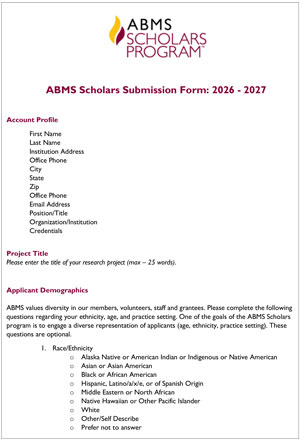
Applications to the ABMS Scholars Program are completed through the Cadmium Abstract ScoreCard platform. A PDF of the application is provided for reference.
Questions?
If you have any questions, please contact the ABMS Scholars Program for more information.