After graduating from a residency or fellowship training program, residents and fellows are that much closer to pursuing board certification by an American Board of Medical Specialties (ABMS) Member Board. The key question is, “Are they prepared to provide unsupervised patient care?”
When medical specialties decide to change the approach to answering that question, it’s easy to see how the Accreditation Council for Graduate Medical Education (ACGME), which oversees graduate medical education training programs, and ABMS, which certifies physicians, play a role in supporting this change.

Individuals gain the appropriate knowledge, skills, and behaviors during medical training to become board certified physicians. The processes involved have been and remain intimately aligned and connected, noted Greg Ogrinc, MD, MS, Senior Vice President of Certification Standards and Programs at ABMS. “The work of ACGME and ABMS must fit together hand in glove, so the collaboration on these programs is important to ensure the highest quality training programs that lead to initial and continuing certification for individuals,” he said.
To that end, ABMS has established learning communities to assist its Member Boards as they consider the benefits and implications of Competency-Based Medical Education (CBME) across the specialties, and how best to collaborate with the specialty-specific educational community, specialty societies, and other interested parties to move the outcomes-oriented approach forward. Among those that Member Boards are typically collaborating with on CBME are specialty-specific education leaders; residency program directors; designated institutional officials; and ABMS Associate Members, such as ACGME, the American Medical Association, and Association of American Medical Colleges.
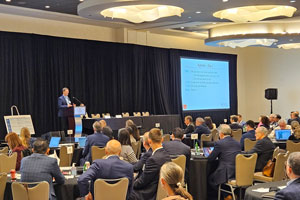
In 2022, ABMS established the ACGME-ABMS CBME Learning Community that meets twice a year; once in person and once virtually. Speakers often include experts in the field. Dr. Ogrinc has seen the evolution and depth of conversations continue to expand at these meetings. Four years ago, participants asked questions such as, “What is CBME?” and “Why is it important to adopt this approach?” “Now, the conversations are about how this framework applies to each specialty,” he said. In addition, the number of participants continues to increase, another indication of the growing interest in this work.
In 2023, ABMS established the CBME Interest Group, which meets virtually three times a year. At the meetings, Member Boards share and compare practices for collaboration, development, financing, administration, and validation of CBME in each specialty. Participants home in on CBME-related issues that are specific to the boards, Dr. Ogrinc said.
Both opportunities promote honest and transparent feedback that has helped with the spread and implementation of CBME, Dr. Ogrinc explained. Specialties that are farther along the journey (e.g., already implementing or maintaining CBME processes) can provide guidance to those specialties that are in earlier phases of the journey (e.g., exploring or pilot testing Entrustable Professional Activities [EPAs]). “We have taken a ‘sow and grow’ approach to the community, providing the opportunity for each specialty to move at its own pace and learn about the processes and implementation needed for the specific stage they are in,” he said. “This can make for a bit of chaotic interactions, but there can be a lot of learning in those interactions.”
The challenges keeping the specialties from implementing CBME remain the same from Day 1, Dr. Ogrinc noted. Many specialties lack CBME expertise to guide them, for example, on how best to define educational outcomes of training, which will serve as the basis for their EPAs, or determine what system to use for collecting the frequent observations/assessments that are often used in CBME. All this work requires funding for leadership, faculty development, and technical platforms. “We know that the timeline for moving to CBME implementation is seven to ten years,” he said, adding, “There is a lot of work that needs to happen over a considerable period of time.”
In the meantime, ABMS remains committed to supporting its Member Boards. Plans are underway for the ACGME-ABMS Learning Community virtual meeting in fall and the May 2027 in-person meeting. Additionally, ABMS is considering hosting one-hour CBME toolkit sessions that will focus on topics such as writing EPAs and using a portfolio approach to assessment, among others.
© 2026 American Board of Medical Specialties
Read the latest issue of ABMS Insights and sign up to receive future updates about board certification.